Náučný chodník / Educational Trail
Slovensky
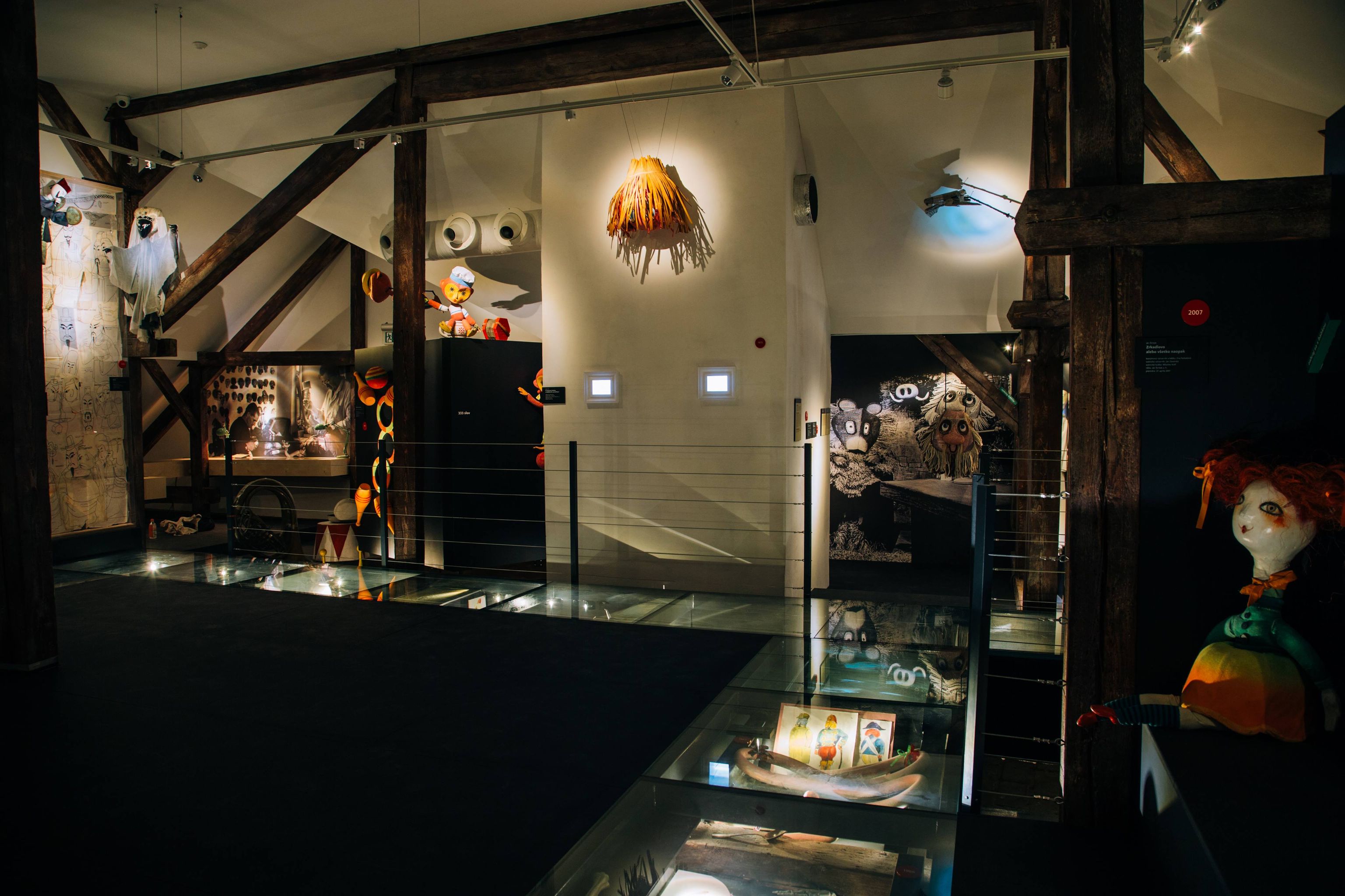
Presklenný náučný chodník chronologicky mapuje históriu hier najstaršieho kamenného bábkového divadla na Slovensku. Môžete na ňom nájsť predstavenia, ktoré boli odohrané počas prvých 16 rokov fungovania Bábkového divadla Žilina. Jednotlivé predstavenia sa vtedy ešte hrávali v prístavbe bývalej synagógy. Boli to slovenské a české hry, ktoré súbor hrával s marionetami. Divákom ponúkli skoro každú nedeľu novú hru, čo muselo byť veľmi náročné. Marionety viedli amatérski vodiči, zatiaľ čo profesionálni členovia činohry mali na starosti recitovanie. Popri marionetách sa objavovali aj javajky, ktoré postupne začali dokonca prevažovať. Až neskôr pribudli maňušky. Marionetová tradícia po roku 1952 v Žiline zanikla, pretože javajky a maňušky boli pohybovo živšie a výrobne menej náročné typy bábok.
Prosím postupujte chronologicky podľa rokov.
V prvých predstaveniach sa Bábkové divadlo Žilina zameralo na výchovu detí a mládeže. Prostredníctvom hier sa deti oboznamovali so základnými morálnymi hodnotami, zásadami slušného správania či hygienickými návykmi.
Prvá inscenácia Mášenka a medveď je z roku 1952. Hra bola napísaná formou jednoduchého textu pre potreby učiteliek v materských školách. Inscenáciu nafotil vtedy začínajúci fotograf Karol Kállay, ktorý je dnes považovaný za jedného z najlepších slovenských fotografov. Návrh scény s bábkami javajkami vypracoval zakladateľ divadla Teodor Zvara. Mal na starosti výrobu a stavbu scény na javisku a samozrejme v predstavení vodil aj bábky.
Od roku 1953 sa Bábkové divadlo Žilina zameriavalo na zájazdovú činnosť, ktorú rozšírilo na celé územie Slovenska. Po roku 1954 sa dokonca na čas stalo iba zájazdovým divadlom. To znamená že, herci nehrávali v domovskom divadle, ale cestovali za divákmi do rôznych kútov krajiny. Dôvodom bolo, že priestory divadla mali vtedy slúžiť iným účelom. Ako náhradu dostalo divadlo v pôvodnej budove aspoň javisko a pomocné priestory za javiskom. Hľadisko v tej dobe slúžilo ako telocvičňa, takže súbor mohol skúšať len vtedy, keď nebol rušený prevádzkou v telocvični. Na zájazdovom divadle bolo zaujímavé napríklad to, že herci cestovali v skorých ranných hodinách na starom aute, ktoré museli neraz do kopca tlačiť. Len čo posádka dorazila do cieľa, museli s vybaľovaním pomáhať všetci jej členovia, herec – neherec, nie len obslužný či technický personál. Každý kúsok javiskovej konštrukcie bol zabalený do vreca. Rekvizity s dekoráciami boli obalené v zamatovej látke, aby sa pri preprave nepoškodili. Bábky sa balili zvlášť a veľmi opatrne. Predsa len, boli z celej divadelnej výbavy najdôležitejšie. Vybaľovať sa muselo rýchlo. Svižný pohyb bol nevyhnutný, pretože sály neboli dostatočne vykúrené a teplo by z nich inak ešte viac unikalo.
K najlepším inscenáciám tohto obdobia patrí inscenácia sovietskej hry Čarovná galoša z roku 1954. Ruské a sovietske hry boli veľkým obohatením repertoáru. Hralo sa s javajkami, ktoré stvárňovali rozprávky o zvieratkách ako nositeľoch ľudských vlastností. Hra bola poučná, viedla deti k dodržiavaniu hygienických návykov a morálnych zásad.
V roku 1956 opäť divadlo získalo celú budovu späť a za štyri dni ju prispôsobilo potrebám svojej prevádzky. Zájazdy sa obmedzili, pretože sa čas venoval rozšíreniu repertoáru a skúšaniu nových hier. Súbor bol doplnený ďalšími talentovanými ochotníkmi a tiež bábkohercom, režisérom a dramaturgom, Vladimírom Predmerským.
Nasledujúcou inscenáciou je Kaimovo dobrodružstvo z roku 1956, v ktorej život ľudí v Afrike herci stvárnili marionetami. Bol to vtipný príbeh o malom černošskom chlapcovi, ktorého prežité nebezpečenstvá a dobrodružstvá v prírode zbavia nezdravej túžby po neobyčajnej práci. Dodajme, že aj lenivosti a tvrdohlavosti. Hra rozprávala deťom citlivo o tolerancii medzi jednotlivými rasami.
Pri ďalšej inscenácii Perníková chalúpka neprehliadnite prosím fotografiu uvádzačky, ktorá kedysi zastávala v bábkovom divadle dôležitú úlohu. Nielenže deti posadila na svoje miesta v hľadisku, ale im aj porozprávala niekoľko viet o režisérovi, výtvarníkovi, hercoch a pod. Následne ich uviedla do deja divadelnej hry, ktorú o chvíľu uvideli v podobe bábkového divadelného predstavenia na vlastné oči. Dnes už uvádzačky toto v divadlách nerobia.
S televíziou za Dedom Mrázom je ukážkou toho, čo marionety dokážu ak imitujú cirkusové výstupy. Inscenácia bola spomienkou na slávne marionetové obdobie ochotníckeho súboru Radosť, na čele ktorého stáli zakladateľ Bábkového divadla Žilina, Teodor Zvara spolu s Bohušom Žďarským.
Lietajúce bačkory boli orientálnou bábkovou hrou, ktorú režíroval už spomínaný Vladimír Predmerský. Jej inscenovaná podoba mala trochu pozmenený názov, ktorý znel veľmi originálne až veselo – Lietajúce bačkory alebo Šuki a Muki. Išlo o prvú inscenáciu s výpravou bábkara a pedagóga Martina Bálika. Je tiež ukážkou jeho výtvarných návrhov. Vo výstave sa nachádza originál bábky javajky, zhotovenej práve Martinom Bálikom.
Myšlienkou hry Hračky na cestách, inscenovanej v roku 1959, je vážiť a šetriť si svoje veci, aby nám mohli byť užitočné a slúžiť k našej radosti. Hra je o tom, ako plyšový macko, lopta a kolobežka utiekli deťom, ktoré s nimi zle zaobchádzali. Tri dni sa túlali po svete, až kým si ich neosvojili deti v materskej škôlke. Pointou hry bolo poukázať na súdržnosť kolektívu pri prekonávaní prekážok a šetrné zaobchádzanie s hračkami.
Od roku 1960 vznikol v Bábkovom divadle Žilina zvozový systém. To znamená, že divadlo začalo pravidelne voziť deti z okolitých miest na svoje predstavenia. Takto mohli prísť do divadla aj deti, ktoré bývali mimo Žiliny či v takých mestách a dedinách, ktoré nemali vhodné alebo dokonca nijaké podmienky pre odohratie profesionálneho predstavenia.
Inscenácia Na počiatku bola nuda bola satirická revuálna komédia o stvorení sveta. Jej autor sa voľne inšpiroval učením Mojžiša a francúzskym karikaturistom Jeannom Effelom. Za pozornosť stojí, že bola určená mladým divákom od 12 rokov a dospelým.
Hru na objednávku divadla napísal dramatik Juraj Váh a prešla úradnou cenzúrou. Cenzúra znamená, že text hry oficiálne skontroloval úradník, niekedy nazývaný aj censor. Mal zistiť a posúdiť, či je jej obsah vhodný alebo nie, prípadne požadovať úpravy. V hre sa rozvíja zápletka medzi Pánom Bohom a Luciferom. Dramatik Váh sa ujal myšlienky celkom originálne, pričom sa nechal inšpirovať pôvabným seriálom kresbičiek spomenutého ilustrátora a novinára Jeanna Effela.
Po prvý raz v histórií profesionálneho bábkového divadla na Slovensku sa v inscenácii použilo čierne divadlo, luminiscencia a filmová projekcia. Čierne divadlo funguje na základe princípu kontrastu svetla a tmy. Celý priestor javiska je spolu s hercami v čiernej farbe. Herec tak splýva s čiernym pozadím a stáva sa pre diváka neviditeľným. Pri bočných vchodoch sú silné svetelné zdroje, ktoré vytvárajú akúsi svetelnú štrbinu. Takéto divadlo pracuje tiež s ultrafialovým svetlom, v ktorom niektoré farby žiaria, preto ich voláme luminiscenčné.
Ďalšia inscenácia z roku 1961 sa nazýva Cínový vojačik. Bola prvou predzvesťou divadla masiek. Divadlo k spolupráci na nej pozvalo činoherného režiséra Pavla Rímskeho, ktorý v prestavení hry autora Sašu Lichého vybudoval na javisku štylizovanú činohru. Išlo o prepojenie činoherného hereckého prejavu, divadla masiek a bábkového divadla. Tento inscenačný zámer podporil aj činoherný výtvarník Zdeněk Pavel. Hercom síce ponechal mimiku tváre, ale celkovo ich zamaskoval tak, že ich ľudská tvár pripomínala skôr masku. Takémuto postupu hovoríme, že ide o štylizáciu ľudskej tváre do podoby masky. Výtvarník použitými materiálmi zdôraznil u hereckých postáv najmä vlasy a fúzy a tiež niektoré kostýmové prvky. Zvýšením predného paravanu zakryl hercom nohy, čím jasne naznačil výtvarnú spätosť hercom stvárňovanej postavy so spodovou bábkou. Vo výslednom pohľade teda herci s tvárou vyzerajúcou ako maska pripomínali zo spodu vodené bábky javajky.
Masky k tejto hre vyrobil slovenský výtvarník, umelecký maskér a herec v jednej osobe Slavoj Urban.
Hru Planéta robotov uviedlo divadlo v roku 1962. Napísal ju dramatik a scenárista Ján Kákoš na objednávku Bábkového divadla Žilina. Jej pôvodný názov bol Čarovné sklíčko. V hre vystupujú postavy Jurka a Zuzky, ktoré sa ocitnú na starej povale plnej odložených vecí. Zuzka nájde okuliare starej mamy a keď si ich nasadí, začnú sa diať zázraky. Veci ožívajú, zjaví sa aj veľký vynálezca Morbul či Zelené magické oko.
Výtvarníkmi inscenácie boli uznávaný český tvorca animovaných filmov Jan Švankmajer, ktorý vytvoril scénu, a jeho manželka Eva Dvořáková, ktorá navrhla bábky. Je to jediná slovenská divadelná inscenácia, na ktorej sa podieľal. Táto spolupráca je jedinečná a vzácna aj preto, že Švankmajer je výtvarníkom, členom skupiny surrealistov a animátorom a filmovým tvorcom, ktorého diela sú známe po celom svete. Pracoval ako scénograf a výtvarník na najrôznejších filmoch doma i v zahraničí. Spomeňme len pár názvov, napríklad Adéla ještě nevečeřela, Deváte srdce či Něco z Alenky, čo bol animovaný film, ktorý natočil v roku 1988 počas svojho pôsobenia vo Švajčiarsku.
V Rozprávkach z truhlice z roku 1963 hrali herci s marionetami tak, že už boli na javisku viditeľní. Diváci mohli vidieť, ako vodia naraz viacero bábok za pomoci dlhých vahadlových tyčí.
Inscenácia hry Túžba po troch pomarančoch (1964) predstavuje divadlo masky. Maska tu na seba prevzala morálnu funkciu. Postavy čistého ľudského charakteru stvárňovali herci bez masiek (napríklad šašo, princ, princezná). Ich náprotivky, teda bezcharakterné, falošné a pokrytecké postavy, hrali zas herci v maskách. Bábky ako napríklad čertíci a piadimužíci dotvárali štýlovú jednotu. Inscenácia v tej dobe vyvolala rozruch, ba až pochybnosti, či môžeme považovať divadlo masiek za bábkové divadlo alebo nie. Prostredníctvom divadla masiek sa však divadlo usilovalo posunúť vekovú hranicu obecenstva smerom k mládežníckemu a dospelému divákovi.
Dramaturg žilinského divadla Jaroslav Pivko pristúpil v roku 1963 k predstave divadla masiek na bábkovom javisku už omnoho cieľavedomejšie. Pri jej realizácii spolupracoval s osvedčeným tímom externých spolupracovníkov – režisérom Pavlom Rímskym a výtvarníkom Pavlom Zdeňkom. Pivko tu preukázal svoju dramatickú rozhľadenosť a k uskutočneniu premysleného inscenačného experimentu vybral rozprávku ruského spisovateľa Leonida Leonova O škriatkovi s dlhým nosom. Nachádza sa v nej motív oživenia drevenej figúrky známy z literárnych diel Pinocchiove dobrodružstvá od spisovateľa Carla Collodiho a Zlatý kľúčik od Leva Nikolajeviča Tolstého. Leonovova metafora o nenahraditeľnosti rodného domova, poskytla inscenátorom priam ideálne možnosti prepojenia bábkových postáv s činohernými, ako aj ich ozvláštnenia maskou. Na základe presne vyhranených typov postáv použili tvorcovia v predstavení bábky – ľudské postavy v maskách. Výtvarník Pavel Zdeňek navrhol do inscenácie masku, ktorá sa pohybovala tak, že na to využívala mimiku hercovej tváre. Bábky zas vodili zakrytí herci systémom čierneho divadla.
O hre Figliar Botafogo z roku 1966 povedal spisovateľ Ľubomír Feldek režisérovi Vladimírovi Predmerskému, že ju napíše za 14 dní. Nakoniec mu to trvalo až 2 roky. Počas tejto doby vzniklo niekoľko jej verzií. Dramaturgovia uviedli hru bez Feldekovho autorského povolenia v Žiline a v Košiciach. V týchto mestách teda spisovateľ k javiskovému uvedeniu jeho hry nedal súhlas. Jedine bratislavskú inscenáciu považoval za autorskú.
Na inscenácii hry Traja veteráni, ktorú napísal známy český dramatik, scenárista, divadelný a filmový herec Jan Werich privítalo divadlo svojho miliónteho návštevníka. Inscenácia mala premiéru v roku 1967 a slovenský spisovateľ Mikuláš Kováč o tomto predstavení napísal: Na prvý pohľad neboli Traja veteráni bábkovým predstavením, je to však iba zdanie, ktoré klame. Divadlo masiek, ako sa tento výrazový systém zvykne nazývať, má však celkom iste bližšie k bábkovému divadlu, ako k činohernému. Maska na tvári mení totiž herca na typ a zároveň determinuje aj jeho výrazové prostriedky k štylizovanému prejavu.
Karel Brožek dostal ako začínajúci režisér a zakladajúci člen legendárneho pražského divadla Semafor v sezóne 1964/1965 jednu z prvých ponúk režírovať bábkové divadlo práve tu, v Žiline. Išlo o inscenáciu Zlatý kľúčik, ktorá mala premiéru v roku 1966. Tvorca sa o tejto skúsenosti vyjadril: „Tady se vlastně stal se mnou ten zázrak vzniku režiséra. Mohu li to tak říct, objevil jsem si v tom představení svůj svět prostředků a postupů, se kterými se setkávam ve svých inscenacích dodnes.“
Karel Brožek si v tejto inscenácii robil sám výtvarné návrhy scény aj kostýmov. Je to jeho prvá inscenácia, ktorú robil v Bábkovom divadle Žilina a hneď vedľa vo veľkej kóji je jeho posledná inscenácia pre toto divadlo – Bidpáj a jeho zvieratká z roku 2004.
English
The glass educational trail chronologically maps history of the oldest stone puppet theatre in Slovakia. You can find performances here that took place during the first 16 years of The Puppet Theatre Žilina. The performances were then played in extension building, the former synagogue. It was the Slovak and Czech plays that were played with marionettes. The audience was offered a new play almost every Sunday, which had to be very demanding. The marionettes were controlled by amateur puppeteers, while professional drama members were in charge of reciting. In addition to the marionette puppets, there were also javaj puppets that progressively began to prevail. Only later on the glove puppets were added. After 1952, the marionette tradition in Žilina ceased to exist because the javaj and glove puppets were more vivid and less demanding types of puppets on production.
Please continue on chronologically.
In the first performances, The Puppet Theatre in Žilina focused on the education of children and the youth. Through the plays, children became acquainted with basic moral values, principles of proper behaviour and hygiene practices.
The first production of The Mashenka and the Bear is from 1952. The play was written in the form of a simple script for the needs of teachers in childcare centres. The production was shot by then beginning photographer, Karol Kállay, who is now considered one of the best Slovak photographers. The design of the stage with javaj puppets was prepared by the founder of the theatre, Teodor Zvara. He was in charge of the production and construction of the stage scene, and of course he also controlled puppets in the performance.
Since 1953, The Puppet Theatre Žilina has focused on touring activities, which have been extended to the whole territory of Slovakia. After 1954, it even became solely a touring theatre for a while. That is, the actors did not play in the home theatre but traveled to their audience in different parts of the country. The reason for this was that the theatre premises were supposed to serve a different purpose at that time. As a substitute, the theatre was given at least the stage and the ancillary spaces behind the stage. The auditorium at that time served as a gym so the ensemble could practice only when not disturbed by the gym operation. The touring theatre was interesting, for example, by the fact that the actors traveled in the early morning hours on an old car which they had to often push up the hill. As soon as the crew arrived at their destination, all of its members, actor or not – not just the service or technical staff – had to assist in unpacking. Each piece of the stage design was wrapped in a canvas bag. The props with decorations were wrapped in velvet fabric to avoid damage during transportation. The puppets were packed separately and very carefully. After all, they were the most important of the theatre equipment. Unpacking had to be done quickly. A swift movement was necessary because the halls were not sufficiently heated and the heat would otherwise diminish even more.
The best productions of this period include the 1954 production of the Soviet play The Magic Galosh. The Russian and Soviet plays were a significant enrichment of the repertoire. The performance was played with the javaj puppets, which portrayed stories of animals as the bearers of human character traits. The play was educative, leading children to follow proper hygiene practices and moral principles.
In 1956, the theatre again got the whole building back and in four days it was adapted to the needs of its operation. Tours were limited because time was spent on expanding the repertoire and rehearsing new plays. The ensemble was complemented by another talented amateur as well as a puppeteer, a director and dramaturge, Vladimír Predmerský.
The next production is The Kaim’s Adventure from 1956, in which actors portrayed the lives of people in Africa with the marionette puppets. It was a humorous story about a little black boy whose dangers and adventures in the wild rid him of unhealthy desires for extraordinary work. And add to that, of the laziness and stubbornness, too. The play tells children in a sensitive manner about the tolerance between different races.
In the next production of The Gingerbread Cottage, please do not overlook a photograph of a female conductor who once played an important role in the puppet theatre. Not only had she guided children to their seats in the auditorium, but she also spoke to them a little about a director, an artist, about the actors, etc. Then she introduced them to the story of the play, which they would see in a short while themselves in the form of a puppet theatre performance. There are no female conductors in theatres anymore these days.
A play With the television to the Santa, is an example of what the marionette puppets can do if they imitate circus performances. The production was a memory of the famous marionette period of the amateur ensemble Radosť, which was headed by the founder of The Puppet Theater Žilina, Teodor Zvara together with Bohuš Žďarský.
The Flying Slippers was an oriental puppet play, which was directed by Vladimír Predmerský. Its staged version had a little different name, which was very original, even humorous – The Flying Slippers or Shuki and Muki. It was a first production of the puppeteer and pedagogue, Martin Bálik. It is also an example of his artistic designs. The exposition features an original javaj puppet made by Martin Bálik.
The idea behind The Toys on the Road play, staged in 1959, is to appreciate and preserve your things so they remain useful and serve to our joy. The play is about how a plush teddy, a ball and a scooter ran away from the children who treated them badly. Three days they wandered around the world until children from the childcare centre adopted them. The point of the play was to bring to attention the unity of the team in overcoming obstacles and the gentle handling of toys.
Since 1960, a collection system has been established in the Puppet Theatre Žilina. This meant that the theatre regularly brought children from nearby towns to their performances. In this way, children who lived outside of Žilina, or in such towns and villages where there was no suitable or even any conditions for a professional performance, could come to the theatre.
The production There was a boredom in the beginning was a satirical revival comedy about the creation of the world. Its author was freely inspired by the teachings of Moses and the French cartoonist Jeanne Effel. It is worth noting that it was intended for young audiences from the age of 12 and the adults.
The play, commissioned by the theatre, was written by a playwright Juraj Váh, and was censored. The censorship means that a public clerk had to at times officially examine the play, sometimes called the censor. He was suppose to identify and assess whether its content is appropriate or not, and request adjustments if needed. In the play, there is a plot between the Lord God and Lucifer. The playwright Váh took the idea in a very original manner while he let himself to be inspired by the charming series of drawings of the illustrator and journalist, Jeanne Effel.
Black theatre, luminescence and a film projection were used for the first time in the history of the professional puppet theatre in Slovakia. Black theatre works on the principle of the contrast of light and darkness. The whole stage area together with actors is in black. In this way the actor merges with the black background and becomes invisible to the viewer. There are strong light sources at the side entrances that create a kind of light slit. Such a theatre also works with ultraviolet light in which some colours shine, so we call them luminescent.
Another production from 1961 is called The Tin Soldier. The play was the first harbinger of the Mask Theatre. The theatre invited a drama director, Pavel Rímsky to collaborate on this play, who built in the performance of an author Saša Lichý a stylised drama on the stage. It was a combination of dramatic acting expression and the mask and puppet theatre. This staging intent was also supported by a drama artist Zdeněk Pavel. Pavel kept actor’s facial mimicry but overall he masked actors in a way that their human face resembled a mask. We say that this is a process of styling a human face into the mask. The artist, by used materials, emphasised mainly actors’ hair and beard and also some of the costume elements. By raising of the front screen, he covered actor’s feet to clearly indicate artistic interconnection of the actor’s character with the below puppet. In the final view, actors with the faces looking like masks resembled from below controlled javaj puppets.
Masks for this play were made by the Slovak artist, artistic make-up artist and an actor in one person, Slavoj Urban.
The play The Planet of Robots was introduced by the theatre in 1962. It was written by the playwright and screenwriter Ján Kákoš as commissioned by The Puppet Theatre Žilina. Its original name was The Magic Glass. The play features characters of Jurko and Zuzka, who find themselves in an old attic full of deferred things. Zuzka finds grandma’s glasses and miracles happen when she puts them on. Things come alive, the great inventor Morbul or the Green Magic Eye will also appear.
The designers here were renowned Czech filmmaker Jan Švankmajer, who created the scene, and his wife Eva Dvořáková, who designed the puppets. It is the only Slovak theatre production Jan Švankmajer participated in. This collaboration is unique and rare because Švankmajer is an artist, a member of the Surrealist group, and an animator and a filmmakers whose works are known worldwide. He has worked as a scenographer and the graphic artist on various films at home and abroad. Let us just mention a few titles, for example, Adela has not had dinner yet, Nine Hearts or Something from Alice which was an animated film he made in 1988 during his time in Switzerland.
In the 1963 The Fairy Tales from the Chest, the actors played with marionette puppets in the way that they were already visible on the stage. An audience could see how they control a number of puppets at once using long rocker bars.
The play The Desire for Three Oranges (1964) presents a theatre of masks. The mask took on a moral function. The characters of a pure human character were represented by actors without masks (e.g. jester, prince, princess). Their counterparts, i.e. vain, fake and hypocritical characters, played actors in masks. The puppets such as devils and dwarfs created styling unity. The production at that time caused a discussion, even a doubt, whether we could consider mask theatre to be puppet theatre or not. Through the mask theatre, however, the theatre sought to move the age group towards the youth and adult audience.
In 1963, Jaroslav Pivko, a dramaturge of the Žilina theatre, approached the idea of the mask theatre on the puppet stage much more purposefully. In its implementation, he collaborated with a well-proven team of external collaborators, a director Pavel Rímsky and an artist Pavel Zdeňek. Pivko demonstrated his broad dramatic knowledge, and chose the fairy tale of a Russian writer Leonid Leonov The Long nosed Goblin, to perform a well thought through staging experiment. The play features the motif of reviving a wooden figure known from the writings of The Pinocchio’s Adventures by a writer Carl Collodi and The Golden Key by Leo Nikolayevich Tolstoy. Leonov’s metaphor on the native home not being possible to replace provided the director with the ideal possibilities of linking puppet characters with the dramatic ones and with their special masks. On the basis of precisely defined types of characters, creators used puppets – human figures in masks. The graphic artist, Pavel Zdeňek, designed for this production a mask, which was controlled by using actor’s facial expression. The puppets were controlled by the covered actors in the black theatre style.
About the play The Jester Botafogo from 1966, writer Ľubomír Feldek told director Vladimír Predmerský that he will write it in 14 days. It took him up to 2 years. During this time, several of its versions were created. Dramaturgists introduced the play without Feldek’s authorial permission in Žilina and Košice. Thus, in these cities, the writer did not agree to the stage introduction of his play. He only considered Bratislava’s production to be authorial.
In the play The Three Veterans, written by well-known Czech playwright, screenwriter, theatrical and film actor Jan Werich, the theatre welcomed its millionth visitor. The production premiered in 1967 and the Slovak writer Mikuláš Kováč wrote about this performance: ‘At first glance, The Three Veterans were not a puppet performance, but it is only the appearances that lies. Mask theatre, how this expression system is called, is certainly closer to puppet theatre than to the drama. A mask on the face changes the actor to the type and also determines his expression means for stylised expression.’
Karel Brožek, was given, as a beginning director and founding member of the legendary Prague theatre Semafor, in the season of 1964/1965 one of his first offers to direct puppet theatre right here in Žilina. It was a production of The Golden Key, which premiered in 1966. The director said of this experience: “It is here where a miracle of becoming a director actually happened for me. If I can say it this way, I have discovered in this performance my world of means and practices that I meet in my productions to this day. ”
In this production, Karel Brožek made his own designs for both, the scene and the costumes. It is his first production directed in the Puppet Theater Žilina and right next in the large booth is his last production for this theatre – The Bidpáj and his animals from 2004.